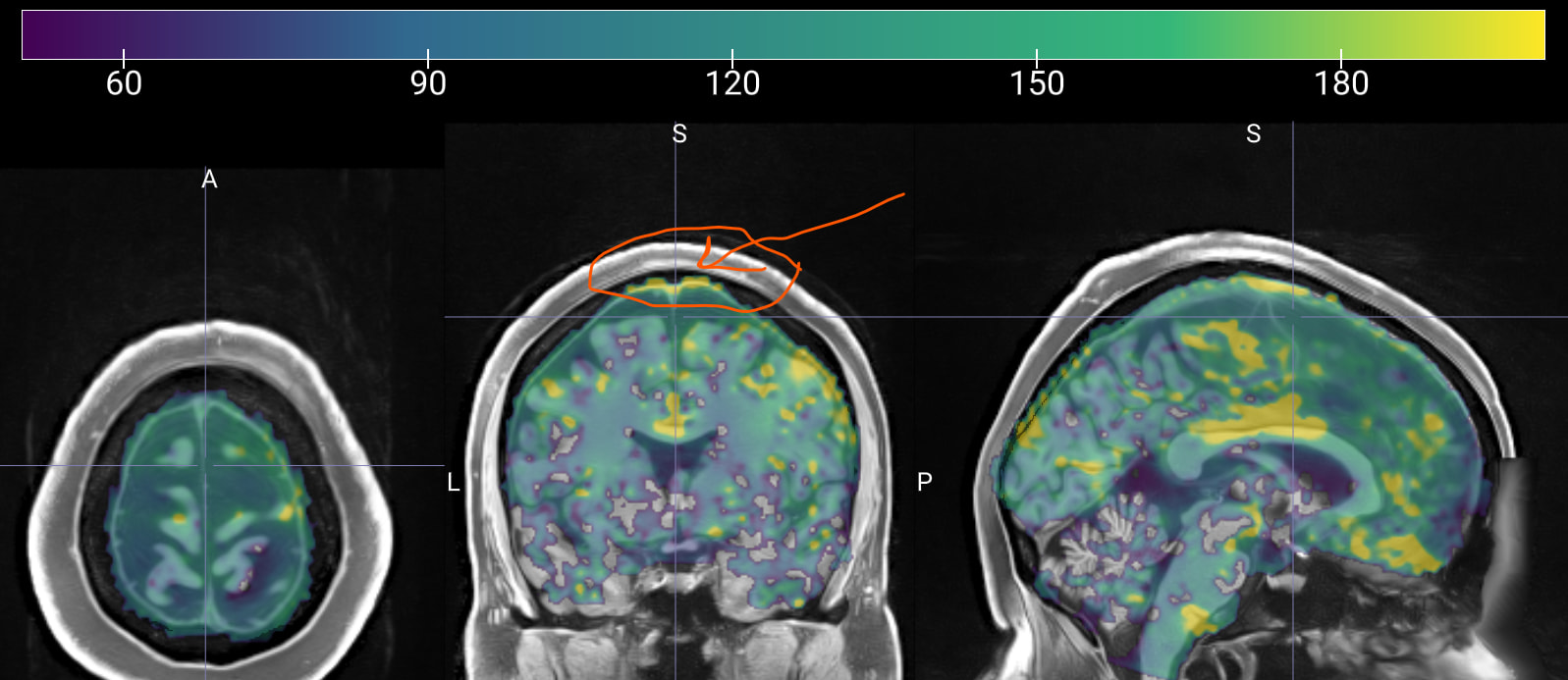
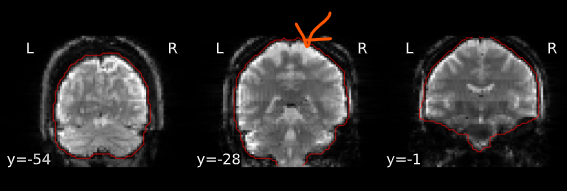
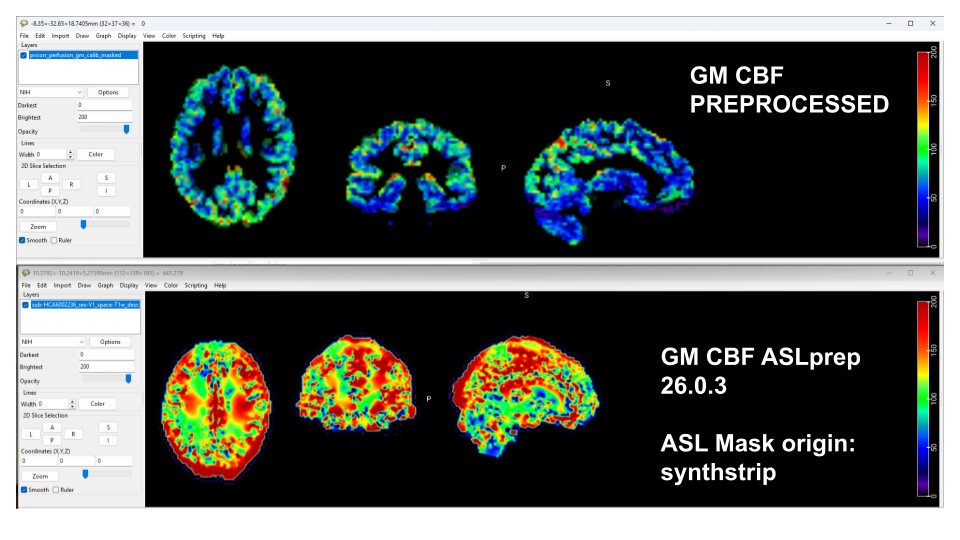
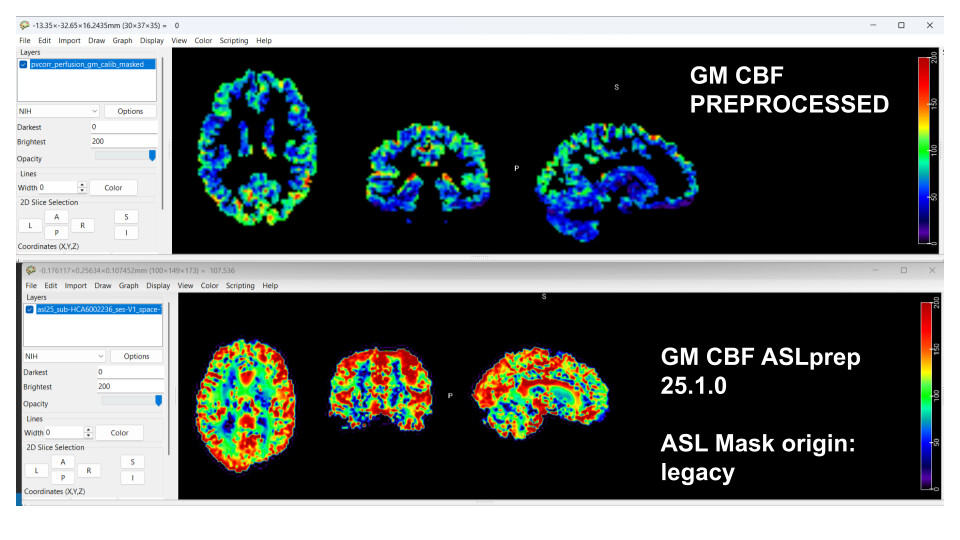
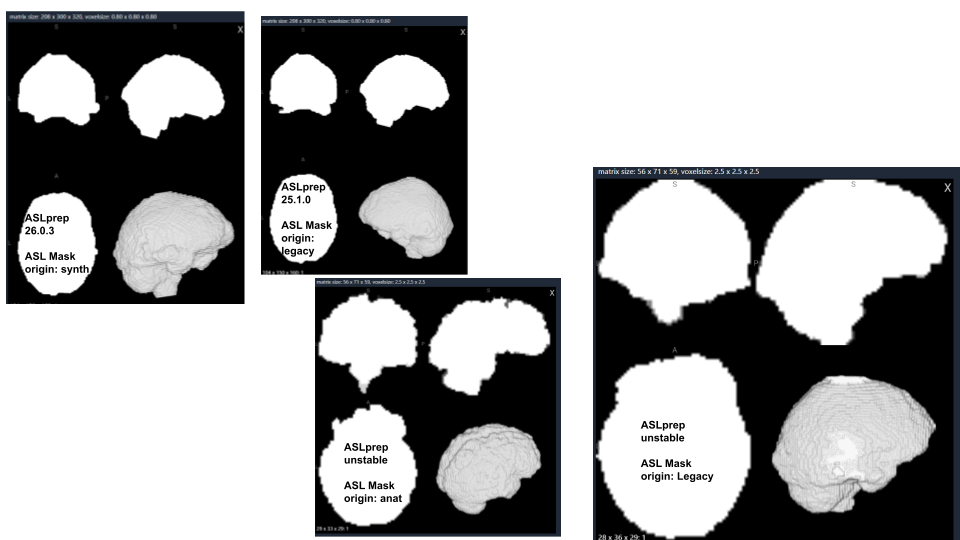
I noticed very high CBF values when exploring BASIL GM CBF. After exploration, the maps seem to be good and accurate, but the issue seems to be with the masks. When I explore the within-subject anatomical outputs, the brain masks look great (/anat/*_desc-brain_mask.nii.gz OR anat/*_space-MNI152NLin2009aSym_desc-brain_mask.nii.gz), but when exploring the perfusion outputs, the masks include non-brain tissue (/perf/*_space-T1w_desc-brain_mask.nii.gz OR /perf/*_space-MNI152NLin2009aSym_desc-brain_mask.nii.gz)
The problem is that masks that include non-brain tissue also include CBF values; even when the CBF values properly delineate brain tissue, some high CBF values still appear outside the brain.
I think the issue arises with the synthstrip implementation. Is there a way I can rerun it with alternative ways to calculate the brain mask for ASL?
Command used (and if a helper script was used, a link to the helper script or the command generated):
Can you not apply the anatomical mask to the perfusion outputs after warping and/or resampling to the same space/resolution?
Unfortunately, there’s no good way to fine-tune with the mask generation approach within ASLPrep right now. It’s one area, along with motion correction, that I am planning to work on over the next month or so, but I have found in the past that ASL sequences are so variable that optimizing the skull-stripping settings for one variant typically makes things worse for another. It may be a good idea to add something like --synthstrip-config to let users control the synthstrip settings, but I’m not sure.
Can you go into a bit more detail about yoru ASL sequence? Are the data public? If I know more, I can try to incorporate a similar sequence into my test suite so I don’t miss it when I work on improving the masking.
This data is from the HCP-Aging dataset (multi-PLD 2D MB EPI pcASL). I remember processing some of it early in the year, and the CBF maps fit brains better (better ASL mask). Perhaps it could be possible to choose to opt in or out of the synthstrip method. I understand how hard it is to find a setting that matches every sequence. Thank you for replying!
That seems like a feature worth adding. So the old approach (pre-SynthStrip) worked best for your data? I’ll look into adding an --aslmask-method parameter or something similar.
EDIT: FWIW, I worked with some collaborators who are using an ASL protocol from the HCP Lifespan project (so the same as HCP-A) and the HCP-ASL pipeline has a number of features that are tailored to that protocol that aren’t in ASLPrep (including some that probably will never be). I just mention this in case using the HCP-ASL pipeline might be better for you.
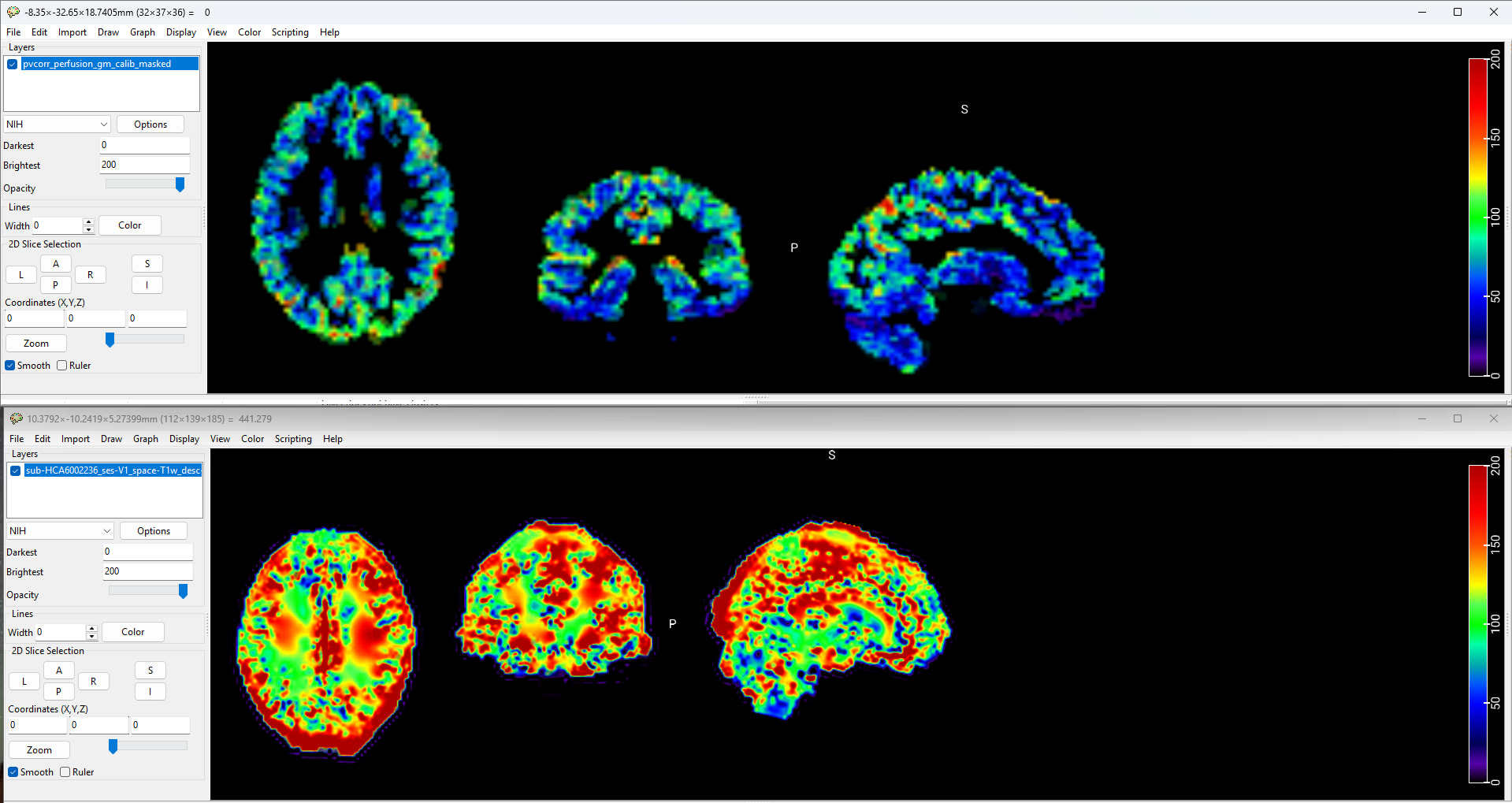
Hi, sorry for the delay in getting back. I’ve been comparing the preprocessed outputs shared by HCP-Aging via Balsa with the values I get from ASLprep 26.0.3 since I suspected the use of the latest unstable version was impacting the values. Interestingly, I get a 2x increase in BASIL PVC GM and WM values. The values get bumped up to non-physiological ranges, but following the same patterns obtained by the HCP ASL pipeline (e.g., a bump up in the intercept for ASLprep mean values per subject). I’m not sure how much the mask is playing a role here, but beyond mask alternatives, I would suggest having more data in the logs on what is passed on to BASIL. The mean values per subject for the CBF maps (not PVC) look quite close. Although I understand there are several considerations made within the HCP-ASL pipeline for this data, I hope the details shared here help improve ASLprep.
See images below:
Upper image: PVC GM CBF from HCP ASL pipeline
lower image: BASIL PVC GM CBF from ASLprep
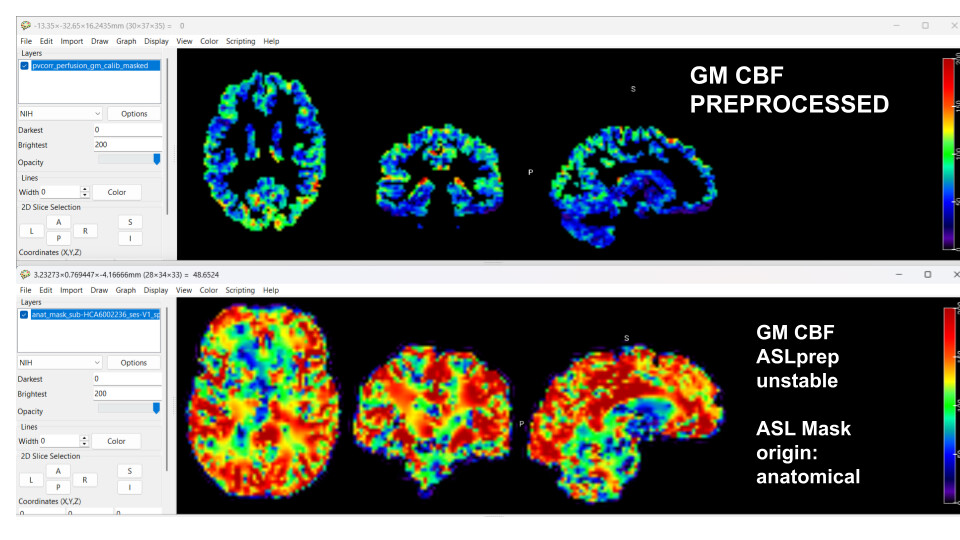
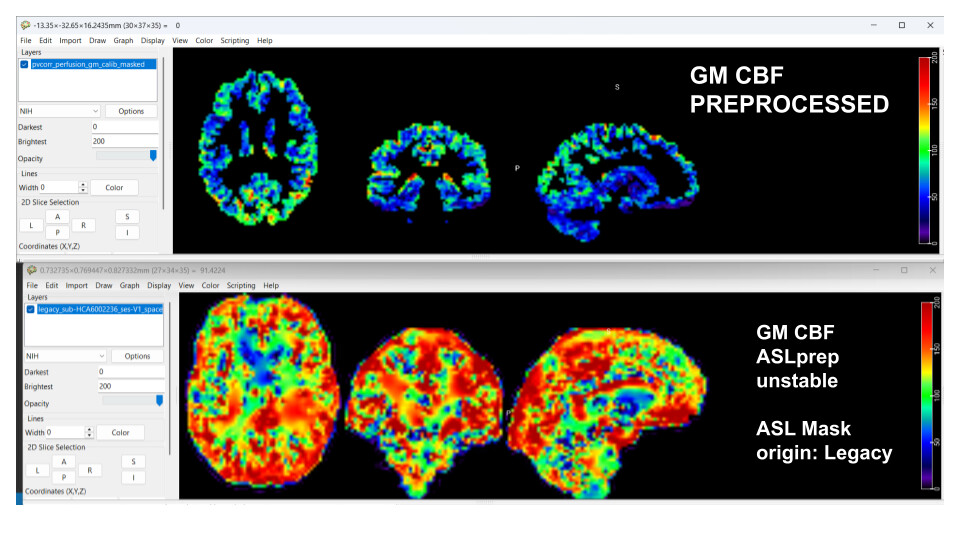
I have added --skull-strip-asl <legacy|synthstrip|anatomical> to give users more control over the brain masking procedure. Also, ASLPrep’s precomputed derivative collection should now grab the brain mask when it is provided through an ASLPrep-like derivative dataset.
Can you try using the current unstable release? I doubt it’ll make a massive difference, but I have made a number of minor changes that might improve your BASIL outputs, including the tissue probability maps that are used for PVC.
Hi, thank you! I will test the unstable version this weekend. For --skull-strip-asl Could you clarify what the difference is between legacy and anatomical? For example, would Anatomical take the T1w mask produced by the FreeSurfer preprocessing?
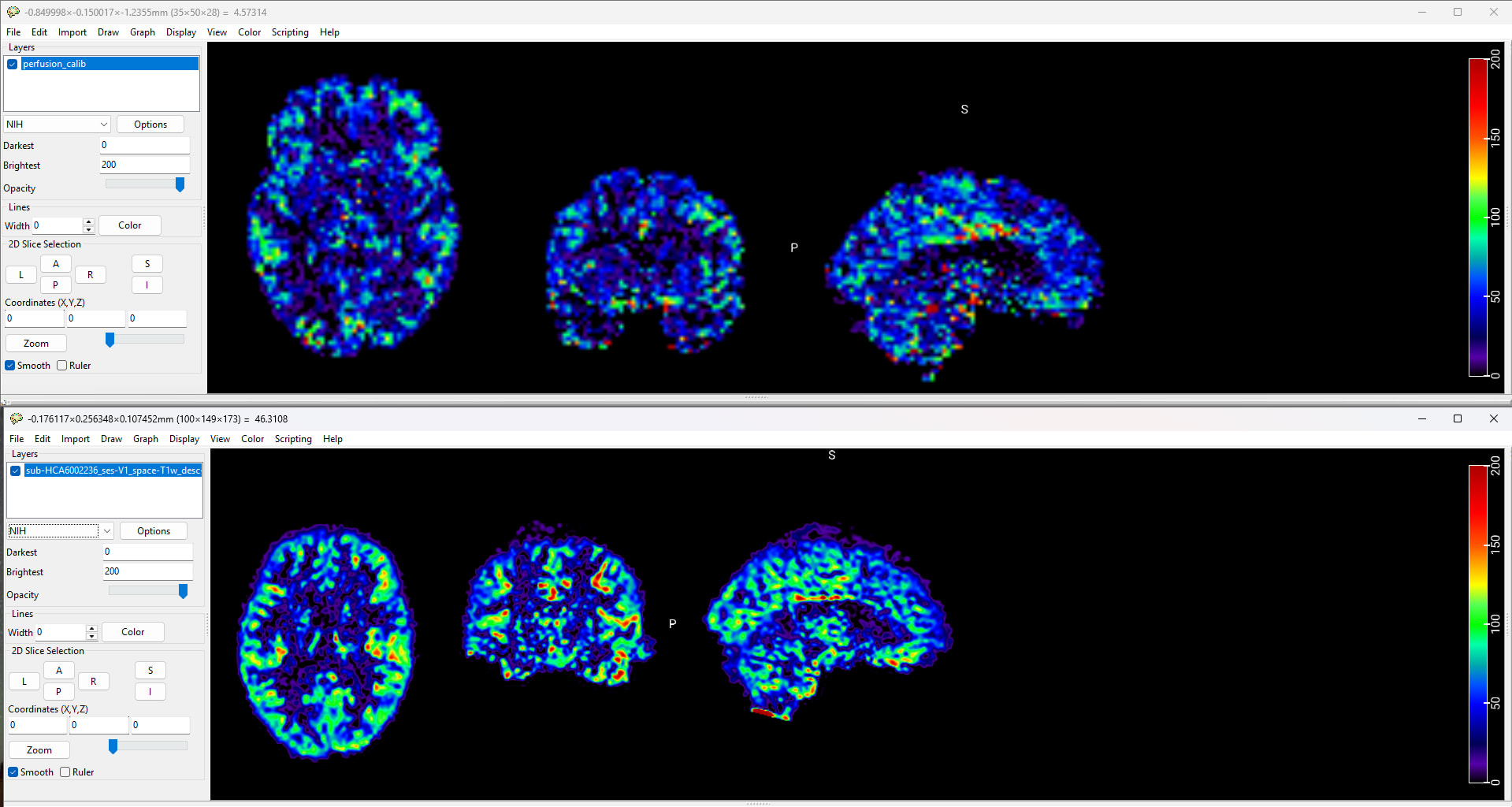
Hi, I found that the --skull-strip-asl flag was beneficial. Unfortunately, the PVC outcomes still show high CBF values. I’ll dig into the ASLprep code to understand how the PVC is done, particularly what is passed to BASIL; if you have any resources, let me know. Below are some pictures illustrating the mask effects and CBF values (0 to 200 ml/100g/min, where 200 is deep red, and 200 is non-physiological), images of GM CBF maps from the same subject, in their native space, for all comparisons. The upper images are CBF maps preprocessed by the HCP-ASL pipeline; the lower images are ASLprep outputs, different versions.