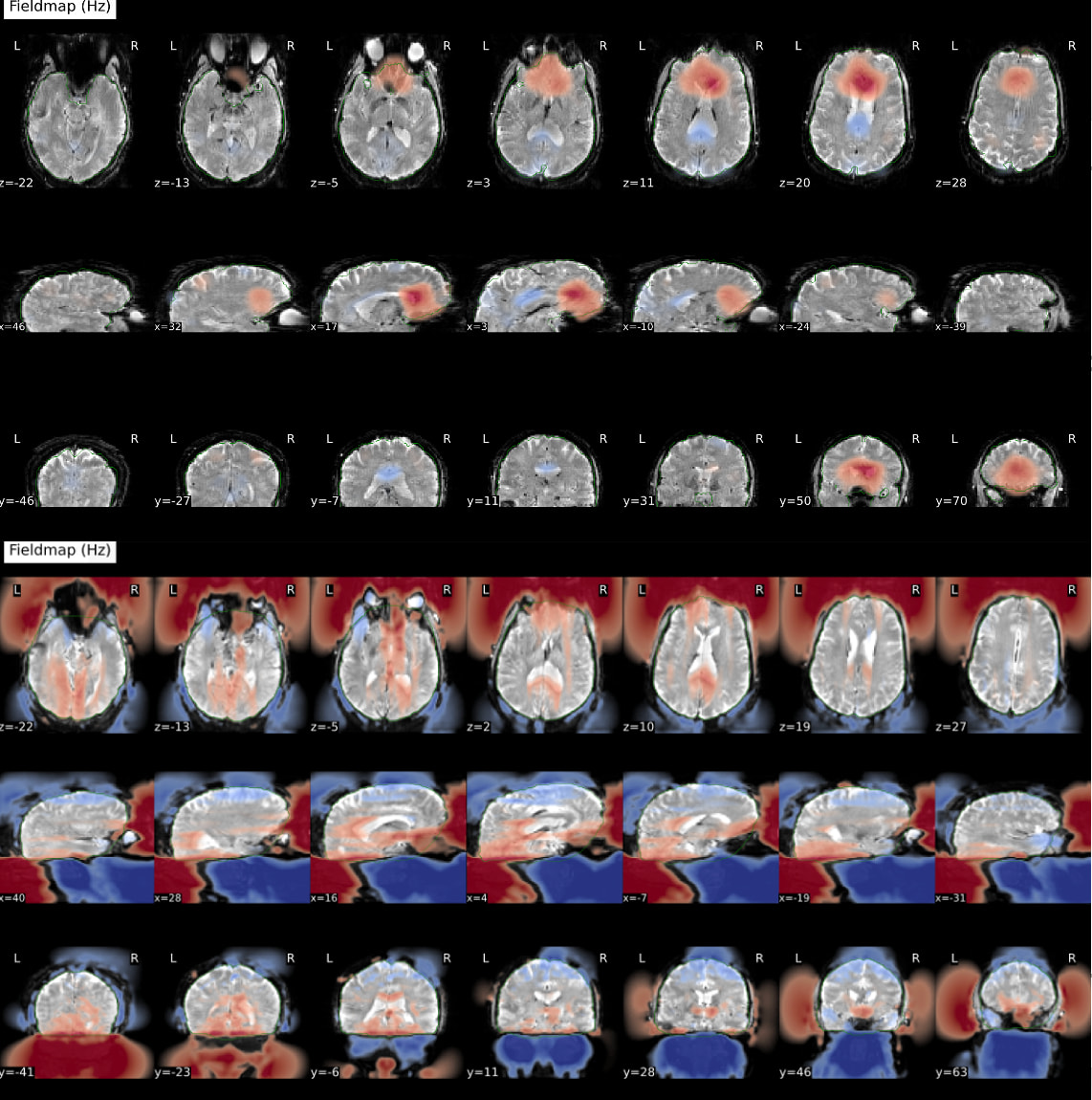
Does anyone have any examples of good or expected outputs for intermediary spatial distortion correction maps generated by fmriprep? We are troubleshooting a few of our own, but are not quite sure what to expect when looking at these maps. We are using both PEPOLAR and SyN for both 3T and 7T resting state scans. I’ve attached a screenshot of a sample subject, the top image is the subject processed using SyN while the bottom is the same subject processed using PEPOLAR.
For additional context, we have a top up scan for this subject that is in the opposite phase encoding direction from their rest scan, but was designed to correct for their task scans (also taken during the same scan) and not their rest. Therefore, the FOV is slightly different from the top up scan compared to their resting state, and we are unsure if PEPOLAR or SyN would be better suited for this subject.
I don’t have any examples to share of those intermediate fieldmaps, partly because what is good vs. bad may depend on the acquisition parameters (like phase encoding direction and gradient strength). But you may find that the coregistration quality between the distortion-corrected BOLD and anatomical image is a more principled metric for how well SDC performed. Also, I’d recommend SynBOLD-DisCo to synthesize a fieldmap over the built in syn-sdc approach.
Regarding the PEPOLAR method, if you are using a scan with one phase direction and different acquisition parameters (different FOV, etc ) to a scan in the opposite direction, I would guess that the PEPOLAR method would not work in that case. To correctly assess the distortions, both images should be identical except for the phase encoding direction. Additionally, the PEPOLAR method uses Spin-Echo (SE) EPI scans rather than GRE-EPI scans, as the drop-out areas inherent in GRE-EPI scans would be misinterpreted as distortions by the PEPOLAR algorithm.
I think this also might be the culprit, the FOV is the same but just cropped in the top up scan compared to the one it is meant to correct for, which might be causing some of these issues. However I can confirm the scans are SE-EPI scans.