How can I obtain C-PAC benchmark reference outputs for v1.7.2 and v1.8.7?

Hello!!

I’m trying to reproduce C-PAC v1.7.2 and v1.8.7 on my own computer. My goal is to verify that my Docker environments, configuration files, and scientific outputs match the official results.

However, I’ve run into two download problems:

1. C-PAC Benchmark Package download doesn’t exist

The official documentation mentions approximately 330 GB of precomputed reference outputs. However, I couldn’t find any downloadable reference data at the provided S3 location,

and I couldn’t find any announcement about the data being moved.

Were these benchmark outputs originally available for public download? Has the link stopped working, have the files been moved, or am I using the wrong download method?

2. C-PAC Regression Testing not avaliable

I also found the official SLURM Regression Testing project, but I could only find the test scripts, configurations, and reports. I couldn’t find a public download location for the independent reference outputs.

Are these reference outputs publicly available, or were they intended only for internal use by the C-PAC development team?

3.How do researchers normally validate a locally reproduced C-PAC environment?:

Is there a currently available official benchmark, or another established method to verify that the reproduced Docker environment, configuration files, and numerical outputs match the official results? Or it can be safely assumed that correct download container and configuration leads to correct results/

Thank you very much for your help!

Thanks for reaching out!

  1. https://s3.amazonaws.com/fcp-indi/resources/benchmark_package.tar.gz (the link from Benchmark Package - C-PAC 1.8.7.dev1 Beta documentation ) worked for me to download the benchmark data unauthenticated.
  2. The regression testing project was deprioritized before ever developing public reference outputs. The internal outputs were generated by running the earliest version of each preconfigured pipeline on the same scans. The HPC space that held those outputs has been reallocated, so they’ll need to be regenerated if/when the project is reprioritized. The raw data for human subjects are available through INDI (for example the raw files with “CORR/RawDataBIDS” in the path can be found in Consortium for Reliability and Reproducibility (CoRR)). The non-human primate data are available from PRIMatE Data Exchange. Unfortunately, the rodent data we were using are not (yet) publicly available.
  3. Since C-PAC acts as a wrapper around many other pieces of software, it’s a good idea to benchmark if you’re working across multiple versions of C-PAC or any of its underlying dependencies. The container images are frozen at time of release, so downloading the same container image should give identical results for deterministic analyses (not all analyses are deterministic, but even the nondeterministic ones should behave the same as one another for the same container image, and from v1.8.3 forward, you can specify the random_seed to make many nondeterministic analyses behave deterministically) If you’re working with a single version, the release notes for C-PAC and the packages relevant to your use-case should be reliably accurate for a given version. That’s not necessarily “correct”, but at least reproducible.

If you’re running a preconfigured pipeline between 1.7.2 and 1.8.7, you should be able to just run the same data through both and compare. If you’re running a custom pipeline, you’ll need to harmonize the configuration files to try to achieve parity between the respective versions. The outputs will almost certainly not be identical across that many different versions (I believe 1.8.7 is 8 versions newer than 1.7.2) since each release contains new features, bug fixes, updated dependencies, and maybe some deprecations, but any discrepancies should be explainable by known differences across the versions.

If you’re interested in contributing to or further developing the regression testing project, I’m happy to facilitate that. We haven’t put any resources toward it in a year and a half.

Hopefully this helps!

Thank you very much for your detailed response! Your guidance has been extremely helpful.

I apologize for not explaining my question clearly enough in my previous message. I’d like to provide a few additional details.

1. Regarding the C-PAC Benchmark Package

I successfully downloaded the package from the link you provided
.

However, this archive is only about 7 MB and mainly contains configuration files, supporting resources, and comparison scripts, rather than the precomputed golden sample Reference Outputs.

The correlations_workflow_pipeline.py script require users to provide two sets of inputs by themselves for numerical comparison.

According to the official Benchmark documentation, my understanding is that there should also be approximately 333 GB of precomputed outputs, intended to serve as reference results against which researchers can compare their own C-PAC outputs.

The documentation points to the following S3 location:

s3://fcp-indi/resources/cpac_benchmark/

However, I was unable to locate this cpac_benchmarkfolder in the exact path in S3 bucket.

After exploring the S3 bucket further, I found a somewhat similar path:

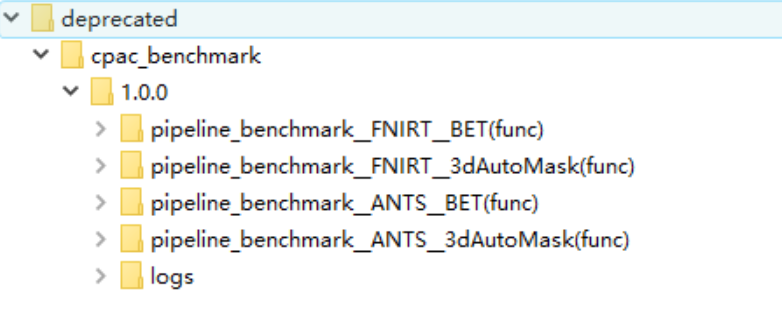
/fcp-indi/resources/cpac/deprecated/cpac_benchmark

However, this directory is under deprecated, and the version I found appears to be an early 1.0 release. I’m therefore unsure whether these outputs would be appropriate for validating C-PAC v1.7.2 & 1.87.

Could you please help clarify whether the approximately 333 GB of precomputed reference outputs mentioned in the official documentation are still publicly available? If so, where can I download them? The deprecated folder?

2. Regarding the Regression Testing Project

Thank you also for explaining the current status of the Regression Testing project and for kindly offering to facilitate my involvement in its further development.

I originally started looking into Regression Testing because I couldn’t obtain the reference outputs for the original Benchmark Package and was hoping to find an alternative way to perform numerical validation

Thanks to your explanation, I now have a much clearer understanding of the differences between these two projects. I believe my immediate priority should be to determine whether the original Benchmark reference outputs are still accessible.

Regarding your kind invitation to contribute to the Regression Testing project, I sincerely appreciate it.

Over the past three years, I have also been working on a separate but related research, during which I have developed some observations and ideas that I hope may prove useful.

My current research will likely keep me occupied for the foreseeable future. But if the work I’m doing produces reliable and useful results, I would be glad to share observations or contribute later in a way that is helpful to the community.

Thank you again for your patience, generosity, and willingness to help. I truly appreciate your time and guidance!

1. Regarding the C-PAC Benchmark Package

[…]

According to the official Benchmark documentation, my understanding is that there should also be approximately 333 GB of precomputed outputs, intended to serve as reference results against which researchers can compare their own C-PAC outputs.

[…]

After exploring the S3 bucket further, I found a somewhat similar path:

/fcp-indi/resources/cpac/deprecated/cpac_benchmark

image

However, this directory is under deprecated, and the version I found appears to be an early 1.0 release. I’m therefore unsure whether these outputs would be appropriate for validating C-PAC v1.7.2 & 1.87.

I believe that section of the documentation is outdated and confusing, and that you’re correct that /fcp-indi/resources/cpac/deprecated/cpac_benchmark are the data referenced by “333 GB copy of our team’s pre-computed outputs”. They aren’t a golden sample, though, just a representative sample. Those data should be largely appropriate for comparison, but the output directory structure changed completely in v1.1.0, so pairing the outputs between these 1.0.0 outputs and the more recent versions could be tedious (though an LLM may be up to the task).

That said, I’m not sure if the value of matching these outputs is worth the effort, unless you have some data processed from C-PAC v1.0.0 or older that you want to validate against. All the regression tests validate is that any changes between versions of C-PAC are expected, but they don’t tell anything about the outputs’ relationship to reality, just between C-PAC versions.

If your question(s) are related specifically to C-PAC versions 1.7.2 & 1.8.7, I’d suggest running the same data through the same pipeline configurations (as much as possible ― many versions of C-PAC include some changes to configurable options, which then involve expected changes in outputs).

If you’re wanting to validate C-PAC to a golden sample, I think that sample needs to come from outside of C-PAC.

Could you please help clarify whether the approximately 333 GB of precomputed reference outputs mentioned in the official documentation are still publicly available? If so, where can I download them? The deprecated folder?

Yes, those are the deprecated data you found.

2. Regarding the Regression Testing Project

There’s only one C-PAC release remaining on the roadmap, and it doesn’t even have a target release date, so facilitating regression tests doesn’t currently make sense as a priority. If/when more C-PAC releases are planned, these priorities will of course be revisited.

Don’t hesitate to reach out if you have more questions.

Thank you very much again for your detailed responses and for all of your help. Your explanations have been extremely valuable to me and have helped me reorganize the priorities of my current work.

I would like to provide a little more background about my research and explain why I have recently been investigating historical C-PAC preprocessing, the Benchmark project, and differences across C-PAC versions.

I am currently developing a theory concerning a specific brain signal and its relationship with a behavioral measure.

In ABIDE I, I have already directly used the officially provided preprocessed no-filter, global regression data , approximately v0.3.9.1, and I obtained a strong and stable relationship supporting this theory.

For this type of study, after the theory, analysis strategy, and main hypotheses are frozen, another independent dataset is also needed for validation. Therefore, I need to use ABIDE II as the independent validation dataset.

The difficulty is that ABIDE II does not provide the same type of preprocessed derivatives for direct download as ABIDE I.

For that reason, I began trying to reconstruct the preprocessing pipeline starting from the raw data.

My initial approach was to rebuild, step by step, an environment and processing workflow as close as possible to the historical C-PAC preprocessed pipeline, including rewriting the wrapping of AFNI, FSL, and ANTs components. I then used the official ABIDE I Direct Download preprocessed outputs as the historical reference golden sample against which to compare my reconstructed results.

So far, I have processed approximately 300 ABIDE I participants.

For about 284 participants, the reconstructed outputs are extremely and scientificallt close to the historical Direct Download results, and some middle stages nearly voxel-exact .

More importantly, for these successfully reproduced participants, the main brain-signal–behavior relationship that I originally obtained from the official ABIDE I preprocessed data is also fully reproduced .

However, there are still some clear exceptions.

At present, these abnormalities are concentrated in the Caltech site .

For a small number of Caltech participants, the reconstructed preprocessing outputs differ substantially from the historical Direct Download results. In addition, roughly a dozen participants cannot complete the reconstruction pipeline at all.

This makes it difficult for me to determine whether the problem is due to:

  • some remaining detail that I have not fully reconstructed in the historical pipeline;
  • specific Caltech subjects or site-specific data characteristics;
  • special processing behavior in the historical C-PAC implementation for these cases;
  • or some other factor that I have not yet identified.

This was also the main reason I originally started looking for the C-PAC Benchmark reference outputs.

My hope was that an official set of golden/reference outputs could first confirm that my C-PAC execution environment and pipeline implementation were behaving correctly, after which I could investigate the unusual Caltech cases independantly.

However, after your previous explanations, I now understand that the Benchmark is better viewed as representative/regression testing rather than as the kind of universal golden sample I had originally hoped to use.

In addition, the output structure, directory organization, and pipeline implementation have changed substantially across C-PAC versions.

Therefore, for now, I have decided to stop pursuing the Benchmark.

Instead, I am taking a more direct approach.

I recently rented a workstation and am preparing to process ABIDE I and ABIDE II at scale using the official C-PAC pipeline.

I am currently planning to use two versions:

  • C-PAC 1.7.2 , because it is relatively close to the historical C-PAC generation associated with the ABIDE preprocessing;
  • C-PAC 1.8.7 , as a newer version, to test whether my research result can also be reproduced under a more recent C-PAC implementation and to avoid relying too heavily on an older preprocessing pipeline when the work is eventually reviewed.

For both versions, the main analysis path will be the same:

no-filter + global regression → fALFF

I have already run a small initial batch of ABIDE I participants using C-PAC 1.7.2.

Interestingly, I am beginning to see that C-PAC 1.7.2 also shows similar abnormalities in some Caltech participants , and I am currently checking whether these are the same subjects that showed problems in my historical reconstruction.

Given the current situation, I have decided to separate the main scientific question from the Caltech preprocessing anomaly.

My immediate plan is to complete:

C-PAC 1.7.2 × ABIDE I + ABIDE II

and

C-PAC 1.8.7 × ABIDE I + ABIDE II

and then first answer the main scientific question:

Can the strong brain-signal–behavior relationship that I discovered in the historical ABIDE I preprocessed data be independently reproduced in ABIDE II, and does the same relationship remain present under both C-PAC 1.7.2 and C-PAC 1.8.7 preprocessing?

If this large-scale analysis works cleanly, and both C-PAC 1.7.2 and 1.8.7 reproduce the same brain-signal–behavior relationship in both ABIDE I and ABIDE II, then I do not plan to continue pursuing the Caltech preprocessing discrepancy.

In that case, the most important scientific questions for my current project—independent replication in ABIDE II and robustness across preprocessing versions—would already have been answered.

On the other hand, if the relationship becomes reproducible only after excluding the Caltech participants whose preprocessing differs substantially from the historical ABIDE I Direct Download outputs, then I will open a separate line of work specifically focused on those Caltech cases, which at first I plan to deal with by benchmark but not necessary anymore.

At that point, I will carefully organize the Caltech cases, the subjects that fail to complete preprocessing from my reconstruction.

If you would not mind, once I have those results organized, I may come back to ask for your advice regarding these more specific Caltech preprocessing and reproducibility issues.

Thank you again for taking so much time to help me understand the Benchmark project, Regression Testing, and the differences between C-PAC versions.

Your explanations have saved me a great deal of trial and error and have helped me focus first on completing the most important ABIDE I / ABIDE II independent validation before deciding whether the Caltech issue needs deeper investigation.

Thank you again very much for your patience, generosity, and guidance. I truly appreciate your help.

1 Like

That all makes a lot of sense. As far as I know, there’s never been an official syntax update of the C-PAC v0.3.9 pipeline config used for ABIDE. That configuration is old enough that the automatic pipeline config syntax upgrade C-PAC attempts won’t work (I just tried).

You of course know better than me the constraints in your research, but my suggestion would be to either:

  1. re-process the raw ABIDE I data with the same configuration and version as the independent dataset (so you’d have ABIDE I preprocessed, ABIDE I reprocessed, and ABIDE II processed the same as ABIDE I reprocessed as 3 processed datasets)
    or
  2. home in on the differences you discovered and tweak the pipeline configuration accordingly.

ABIDE I is old enough that there’s not a container with the 0.3.9 environment, and I’m not sure all of the dependencies as-they-existed-at-that-time will be easy to build today; otherwise, I’d recommend just using that environment for the independent dataset.

Good luck!