first of all, thank you for creating and maintaining this platform my question is related to signal intensity in multi-band DWI data.
Recently, we started to acquire multi-band DWI on our brand-new Cima.X scanner. I already have some experience with single-band diffusion imaging, but I’m new to multi-band.
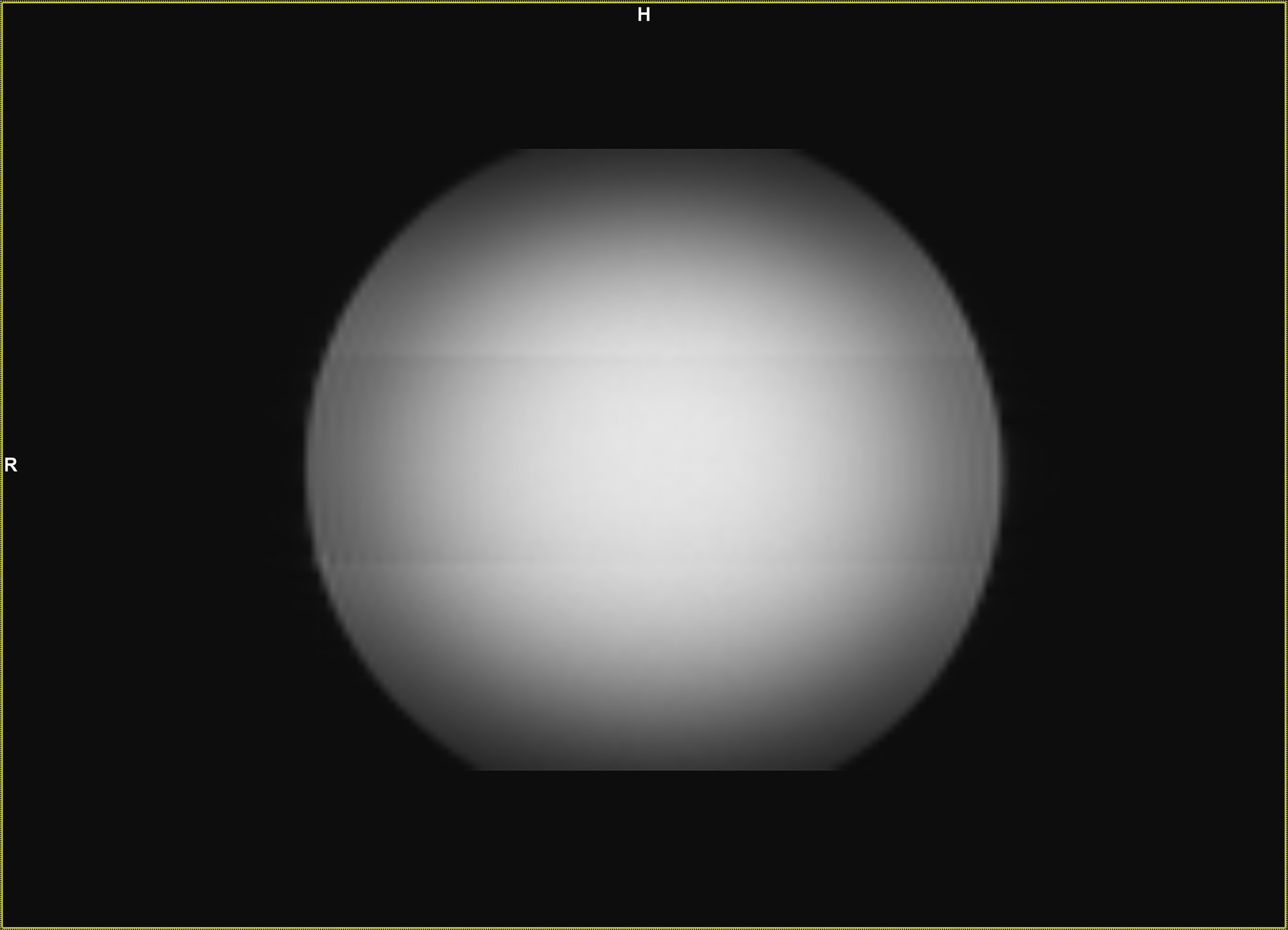
We use the Siemens product SE EPI sequence with MB = 3 and no in-plane acceleration. I noticed that the second slice in each slice group has a different intensity that the remaining two (see image of a phantom below - coronal reformat from the original axial acquisition).
This effect must be due to the length of the excitation pulse which may be too short to describe properly the MB excitation pulse. I don’t think that it is possible to lengthen this pulse in the Siemens sequence. It is possible to do so in the CMRR C2P Multiband sequence at the expense of an increased sensitivity to motion in the phase encoding direction.
Please note that this artefact is usually very visible on the spherical phantom but much less visible in the in-vivo data.
Just one more related question: Are there any other advantages to the CMRR sequence compared to the Siemens product seq. for multi-shell DWI? Would you prefer the CMRR or the Siemens version?
We recently discussed about this question with colleagues who compared both sequences and we noticed a stronger intensity bias for the Siemens sequence (with both sequence having no bias correction selected). This impacted their NODDI calculation. Note that these are empirical, non-published results and we do not understand yet why we saw this difference.
This was noted on Prisma and Cima.X MRI machines, running on XA60 and XA61 respectively, with 64 Head-Neck receive channels.
We tend to prefer the C2P version because if offers access to more advanced parameters. This is generally the case for any C2P. Besides, this C2P was already validated by many multicentric studies.
I would recommend you to run this comparison yourself on your system for a fair validation on which sequence you prefer.
Have you run through your in vivo scans yet? Phantoms definitely exaggerate this more than real data usually shows, so it might not even be worth worrying about once you get actual acquisitions. That’d be the real test.
 my question is related to signal intensity in multi-band DWI data.