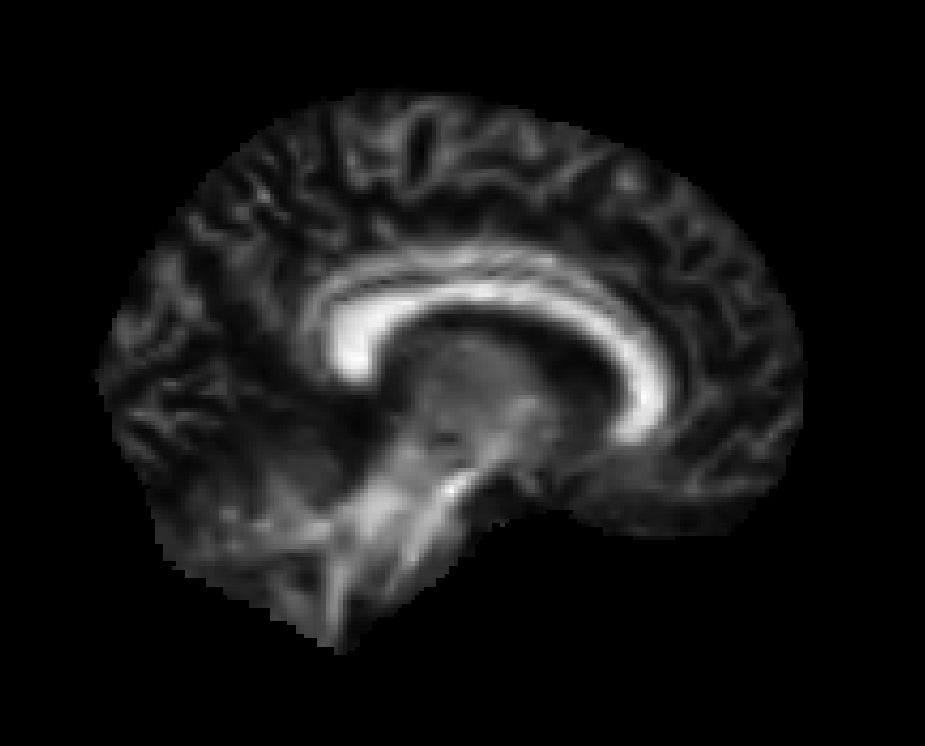
Hello everyone!
I am trying to analyse DTI data using FSL. I preprocessed the data using QSIPrep and output looks good. However, when running TBSS I see some ringing appear in the all_FA.nii along the corpus callosum for most of the subjects. My guess is that it is a registration problem, but I don’t see how to fix it. Would anyone have any insights?
Thank you in advance!
Command used (and if a helper script was used, a link to the helper script or the command generated):
Not a direct answer, but if you just need metrics in a common space, I might recommend using QSIRecon for that. Ringing could be due to the interpolation method. Sometimes using something simple like nearest neighbor can mitigate it.
Hi @Steven, thank you for your fast response! I have looked into it and tried to run it but it crashes eventually - my data has a single-shell acquisition scheme. Would you recommend a specific pipeline suited for that? For now, I am interested in FA, MD values.
Thank you!
Best,
Julia
Yes, you cannot use the ABCD recon spec on singleshell acquisitions. But you can use the metrics from the DSI Studio GQI modeling (which includes tensor metrics).
This pipeline runs GQI modeling (which includes tensor metrics), runs tractography on SS3T FODs, and maps all the microstructural metrics to bundles and to MNI (when you uncomment the last block).
You could do this, or you could use the white matter segmentatino from MNI space as your mask as opposed to getting it from the FA. Also, I do not know what is in your design matrix / contrast file. It could be good to include a quality matrix from QSIPrep (e.g., raw_neighbor_corr or t1post_dwi_contrast).
Please provide more information about your QSIPrep command (e.g., as if you were making a new software support post).
Please also provide the tree directory structure of one subject’s QSIPrep outputs. Also note that QSIPrep does not have nested derivatives folders, only QSIRecon (since each postprocessing workflow is a different derivative dataset produced by QSIRecon).
You can see if any errors were encountered in the output html and/or runtime logs (e.g., SLURM .out/.err files).