Once again I would like to ask for your kind advice.
We have started to acquire images for our research project regarding structural connectivity of the brain on our new Cima.X scanner. We are using the Siemens product SMS EPI sequence to acquire our diffusion weighted images: b0 (10 averages), b1000 (30 directions), b3000 (60 directions) in Free diffusion mode (custom vector directions) with SMS = 3 (more details in the attached JSON).
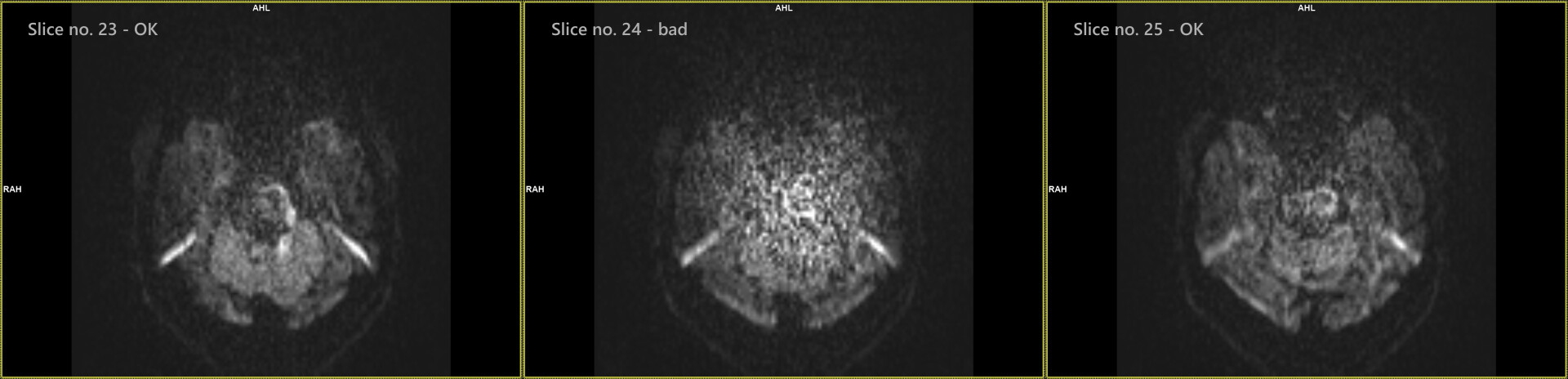
We see quite a lot of slices with signal dropout or (maybe more accurately) noise amplification (see images of three consecutive slices below).
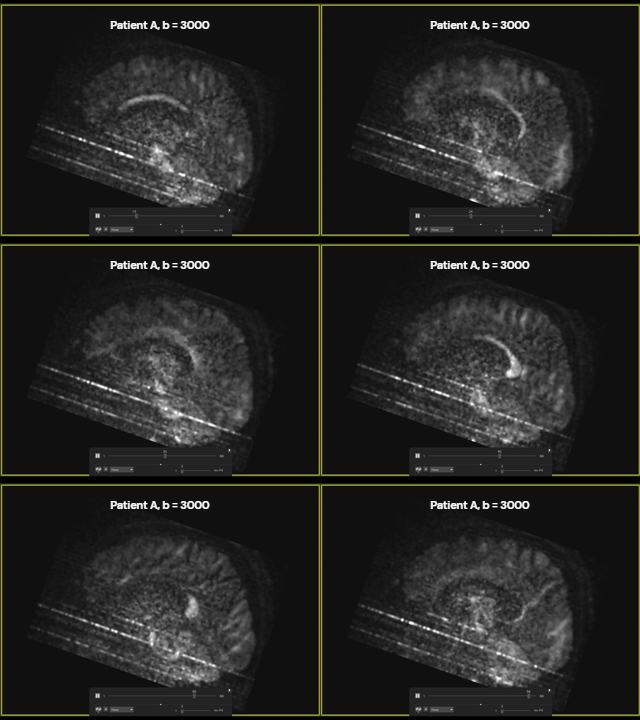
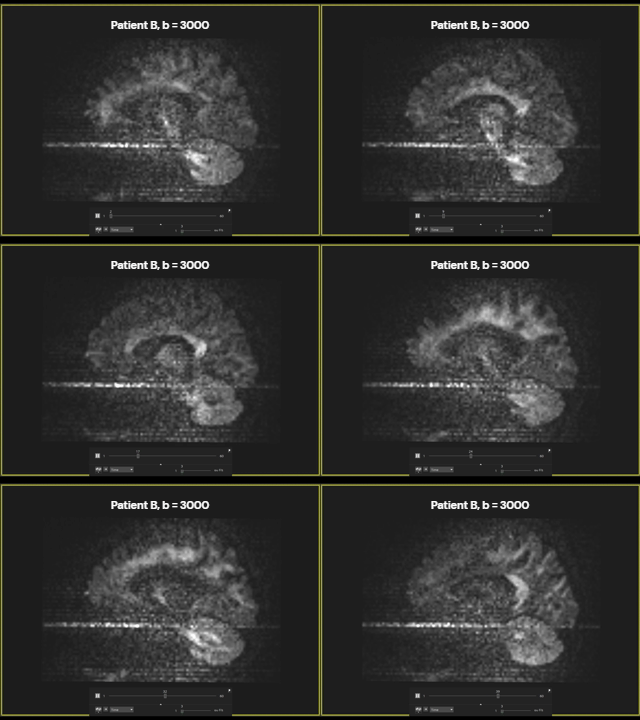
What’s interesting to me is that for a given patient, it affects the same slices across all DWI volumes irrespective of b-value or diffusion gradient direction (for another patient the affected slices would be different - see GIFs below).
We are not sure if this is caused by physiological movements (CSF pulsation, blood flow, bulk movement of the head), a limitation of the acquisition (multi-band?) or if there is something wrong with the scanner/coil (we’re using the Head Neck 64 channel Biomatrix coil, but I ran the built-in coil QC procedure with OK results).
A couple of comments, though I do not think any represent a solution:
The number of reference lines is low (20). For a multi-volume EPI sequence I would set this to the maximum number as the time penalty will be just a couple seconds.
For XA61 I would ensure you are using the current stable release of dcm2niix (v1.0.20260724) instead of one that is more than two years old (v1.0.20240202).
Your rectangular field of view (82% PercentPhaseFOV) provides benefits of a shorter Echo Train Length (ETL) and reduced total readout time which can also reduce echo Time (and in theory help SNR). On the other hand, you will have less overall SNR and are more sensitive to aliasing. This is a complex tradeoff, but it might be nice to see how the sequence does with 100% PercentPhaseFOV.
You note you use custom vector directions. The default Siemens vectors are half shell, but the incremental method of the Caruyer web-based method is still not ideal. You may want to try the generate vectors button with dwi2trx as it uses Winkler’s method with two additional optimizations: it balances vectors and anti-podal across quadrants to help FSL Eddy sampling and it shuffles volumes to minimize the thermal gradient duty cycle.
I tried to increase the number of reference lines but the parameter is not available when iPAT is turned off. Maybe this is a limitation of the product sequence. Do you know if the parameter is available for pure MB acceleration in the CMRR version?
Yes, this was exactly my rationale for using smaller PhaseFOV. We tried also the full-FOV version (albeit with AP/PA PE direction), but the problem persisted.
Thank you very much for the comment, I successfully implemented a diffusion gradient scheme as per your suggestion. Until now we indeed used a vector set generated with the Caruyer algorithm.
Going back to the original problem I noticed that when I ran the sequence with both iPAT (GRAPPA factor = 2, num. of ref. lines = 62) and SMS (factor = 3), the problem completely disappeared. However, I noticed fat suppression did not work as well as without iPAT and the chemically shifted subcutaneous fat from the back of the head severely impacted FOD estimation in the occipital lobe. I’m figuring out how to mitigate this and I will be very thankful for any suggestions.