How many time points are in your data? There should almost always be less than 1/2 the number of components vs volumes and usually less than 1/3. A common reason the ICA does not converge is if it’s given too many PCA components and many of them are just Gaussian noise.
We are having issues with this PCA component selection step that seem to be with the algorithm we use and not specifically tedana. The --tedpca kundu and --tedpca kundu-stablize options use the echo properties of the components to decide which ones to retain for the ICA. This method was distributed with the original code and I conceptually like it, but it’s a bit brittle and hard to understand when/how it fails. The DICE warning you show is from that step.
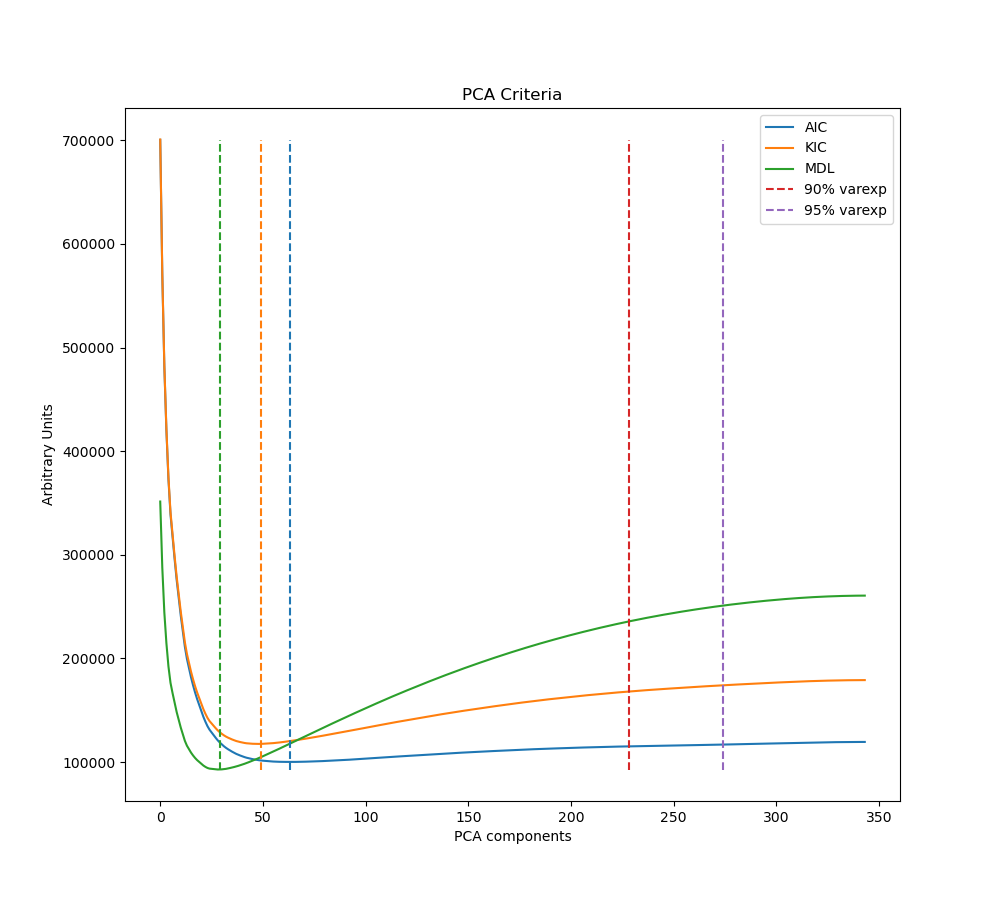
We have 3 other options that are all standard approaches based on cost functions. aic is the most liberal and will retain more components. kic is the moderate option, and mdl is the most conservative. you might want to try kic so see if using it solves that specific issue.
Your issue doesn’t relate to your choice of -tree but I’d recommend sticking with --tree kundu for now. -tree minimal as potential to be better, but it’s stil being evaluated and might change. If you ran the data using aic the output should include ./figures/pca_criteria.png and ./figures/pca_variance_explained.png These are plots of these three cost functions and the estimated components for each one. I’ve included a sample plot of pca_criteria You should see the AIC, KIC, and MDL cost function curve have a local minimum like in the figure and that minimum is the dimensionality estimate for each option. Look at these plots for successful and failed runs and see if any of the cost functions seems a bit more stable across runs.