Hi everyone,
I made a (monolateral) probability map using multiple binary masks registered in AAL atlas.
To make the binary masks: I’ve registered subjects’ images (moving image) in Ch2bet atlas (fixed image) and applied the same transform to ROIs.
Since Ch2bet and AAL (from MRIcron) have the same origin, direction, spacing and shape I had no problem working with both.
The following images are examples of a single mask in AAL, and the probability map in MNI152 and Ch2bet.
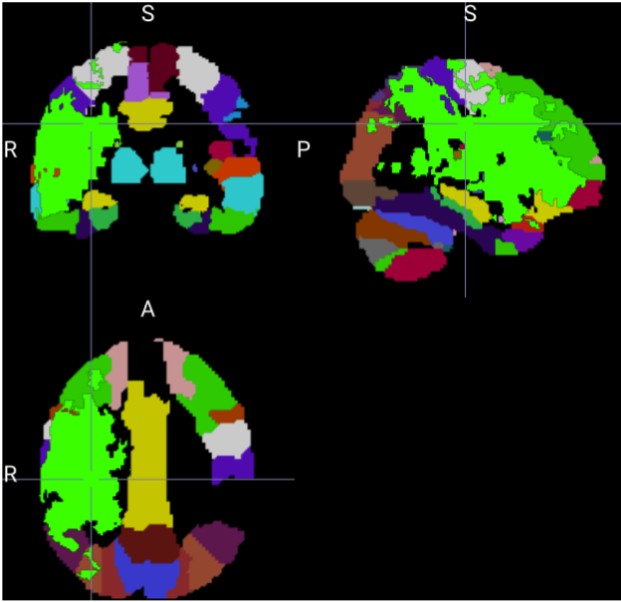
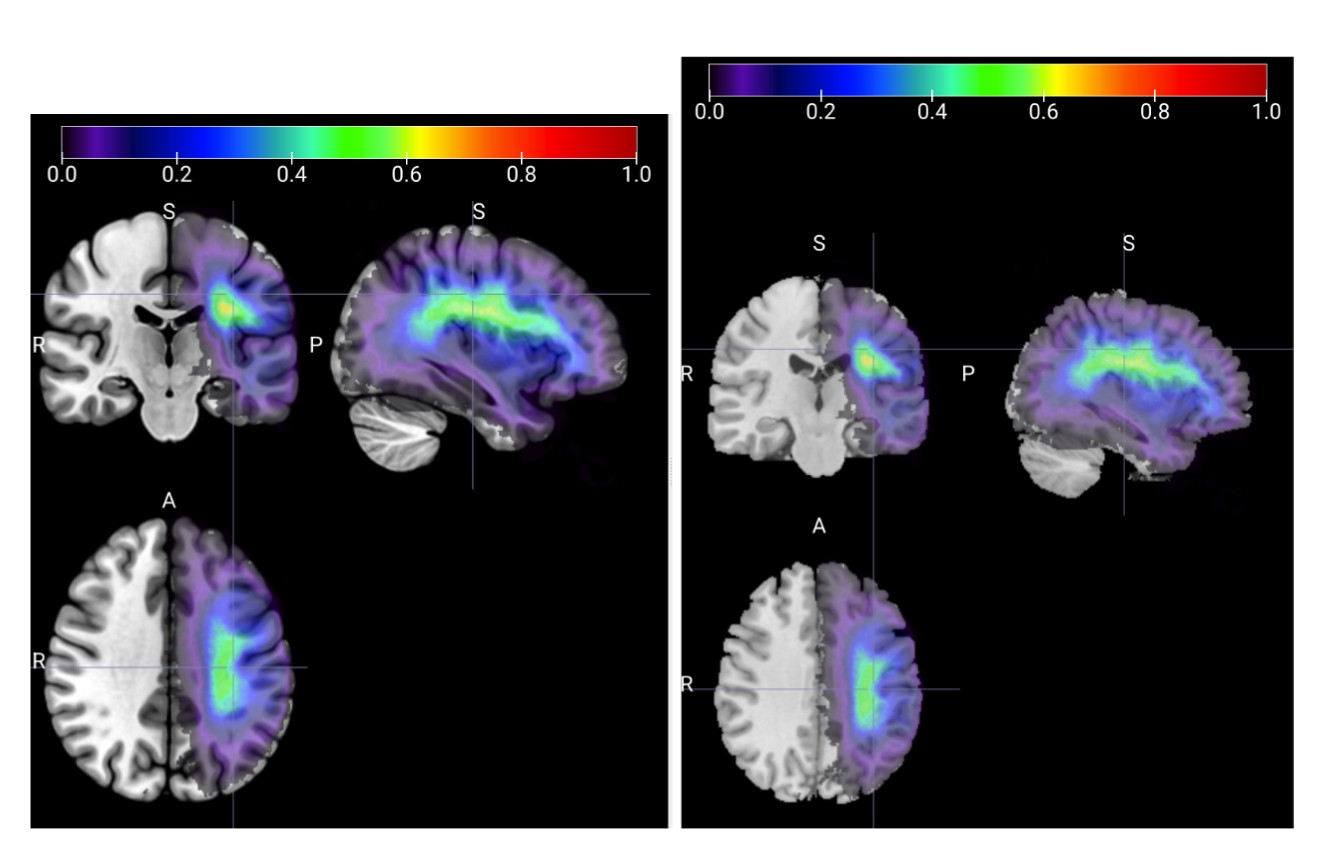
As you can see it seems visually ok, except a minimal distortion in posterior regions, and I’m able to display the map on MNI152 templates using different viewers without any error.
These are the geometric values that I obtained using Antspy (mni 152 from mricrogl):
Origin
O1 (90.0, 125.0, -71.0) mask
O2 (0.0, 0.0, 0.0) mni152
Direction
Direction1 mask [[-1. 0. 0.] [ 0. -1. 0.] [ 0. 0. 1.]]
Direction2 mni152 [[-1. 0. 0.] [ 0. -1. 0.] [ 0. 0. 1.]]
Spacing
Sp1 (1.0, 1.0, 1.0) mask
Sp2 (0.737463116645813, 0.737463116645813, 0.737463116645813) mni152
Shape
Sh1 (181, 217, 181) mask
Sh2 (207, 256, 215) mni152
The question are:
- Is it better for visualization if masks and map have the same geometry (origine, direction, spacing and shape), or can I just use them as they are (visually good)?
- Is it correct to do a simple affine/rigid transformation from Ch2bet to MNI152 and apply the transform to masks and map?
- If I want to perform some statistical analysis on other templates/atlas with different geometry, as MNI152 T1 1mm (from MRIcroGL or FLS) should I first resample all masks/the map in the new space or can I just apply a rigid transformation?
I’ve already read the similar topic " Hammersmith atlas uses the MNI152 template, but array sizes are different? - #3 by lidialuq ".
Thanks in advance.