Thanks, @dowdlelt, your responses are always so insightful!
I’m collecting a pair of short AP-PA scans prior to each run for distortion correction using top-up (I’m collecting ~10 secons of each phase encoding direction, but perhaps that’s too much and I could reduce this and use the SBRef of each phase encoding direction separately?).
I actually already collected some data with GRAPPA2 and 4-5 echos (below are results for a protocol with 7/8 partial Fourier, MB 4, GRAPPA 2, TR-1090 ms, 3.2 mm voxels and TE=13, 27.6, 42.2, 56.8, 71.4 ms). I was surprised that the adaptive mask still had signal for all echos, even for TE=71.4 ms. I think that the issue is that the mask itself is given within the initial EPI brainmask, which excludes regions of low signal like OFC and some temporal regions. See for example here, where tedana’s S0map is overlaid on top of the T1w image:
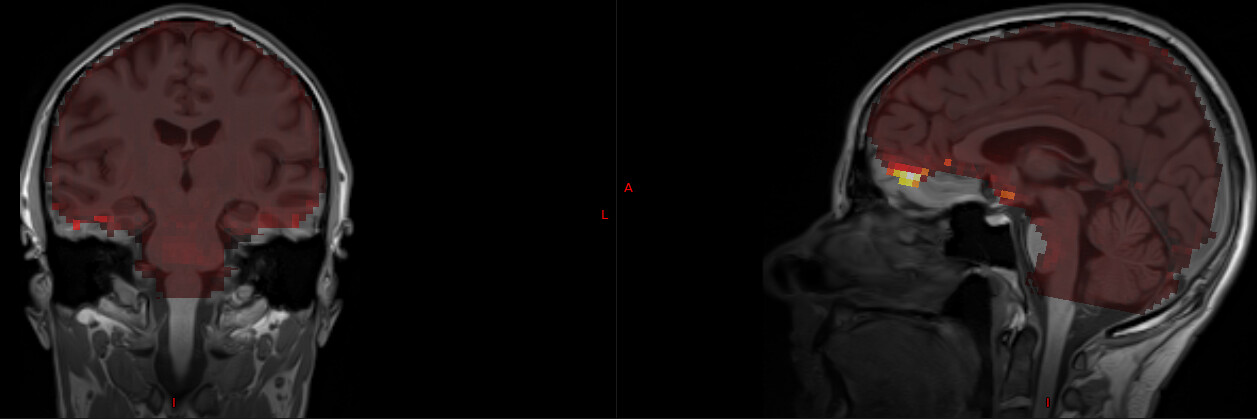
You can also see that S0 is badly estimated at the OFC (as evident by the very high esimation values there).
I therefore reran tedana, but this time I provided it with a mask which is the union of fmriprep’s EPI brain mask and the anatomical brain mask (after regridding to EPI space). This obviously resulted in greater coverage in the S0 map:
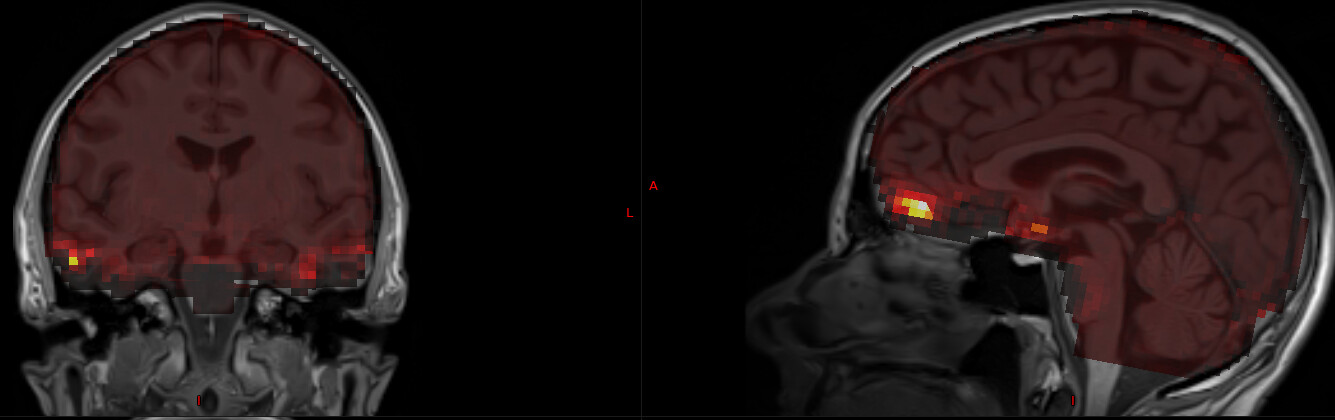
I’m not surprised by the low S0 values there, given how low the signal is even for the first echo (13 ms):
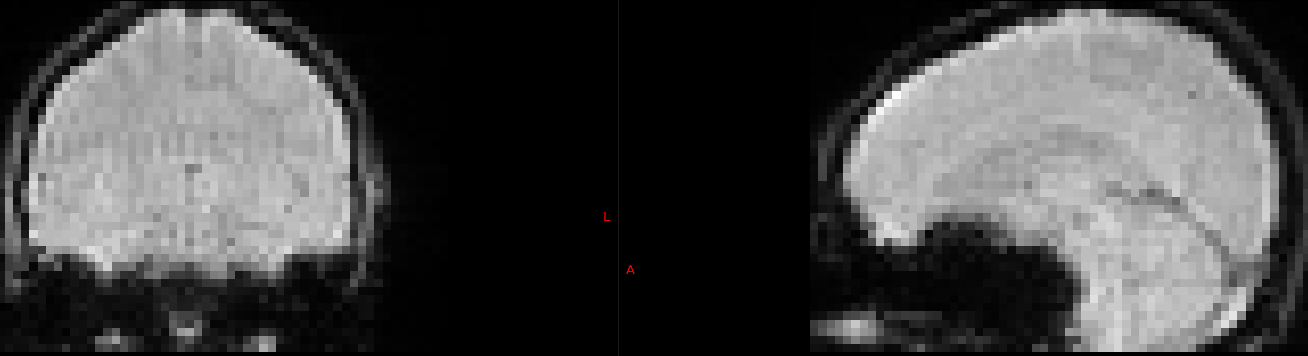
But what surprises me is the adaptive signal mask is still perfect, and equal to 5 throughout the brain (except for a singla posterior voxel equal to 4). I don’t know what I’m missing, but that doesn’t sound quite right.
I chose an arbitrary voxel in the OFC, where the signal seems very low, and plotted the signal against the TE. Given how the linearity breaks in the log(signal) plot it seems plausible that the 5th echo would not be considered as good signal here. But perhaps the conservative way tedana calculated the adaptive signal mask still considers this “good”. Finally, there’s always the possibility that this is a voxel with non mono-exponential decay, especially given the higher probability of partial volume effects with 3.2 mm voxels.
Given that the adaptive signal mask considers these voxels “good”, would you say that combining the EPI mask with the anatomical one is a wise step, or is it too risky in terms of contaminating the data?
Thanks again for your invaluable input!