Hi Jeanette,
Thank you very much for your answer. I actually went through all of your youtube videos to prepare for this topic. So, thank you also for those 
To clarify, the figure above only showed approach 1 and approach 2. But once approach 2 as a simple ANOVA (middle) and once as “ANOVA – within subject” (right). For completeness, I’ve also run approach 3 (in SPM) and updated the figure:
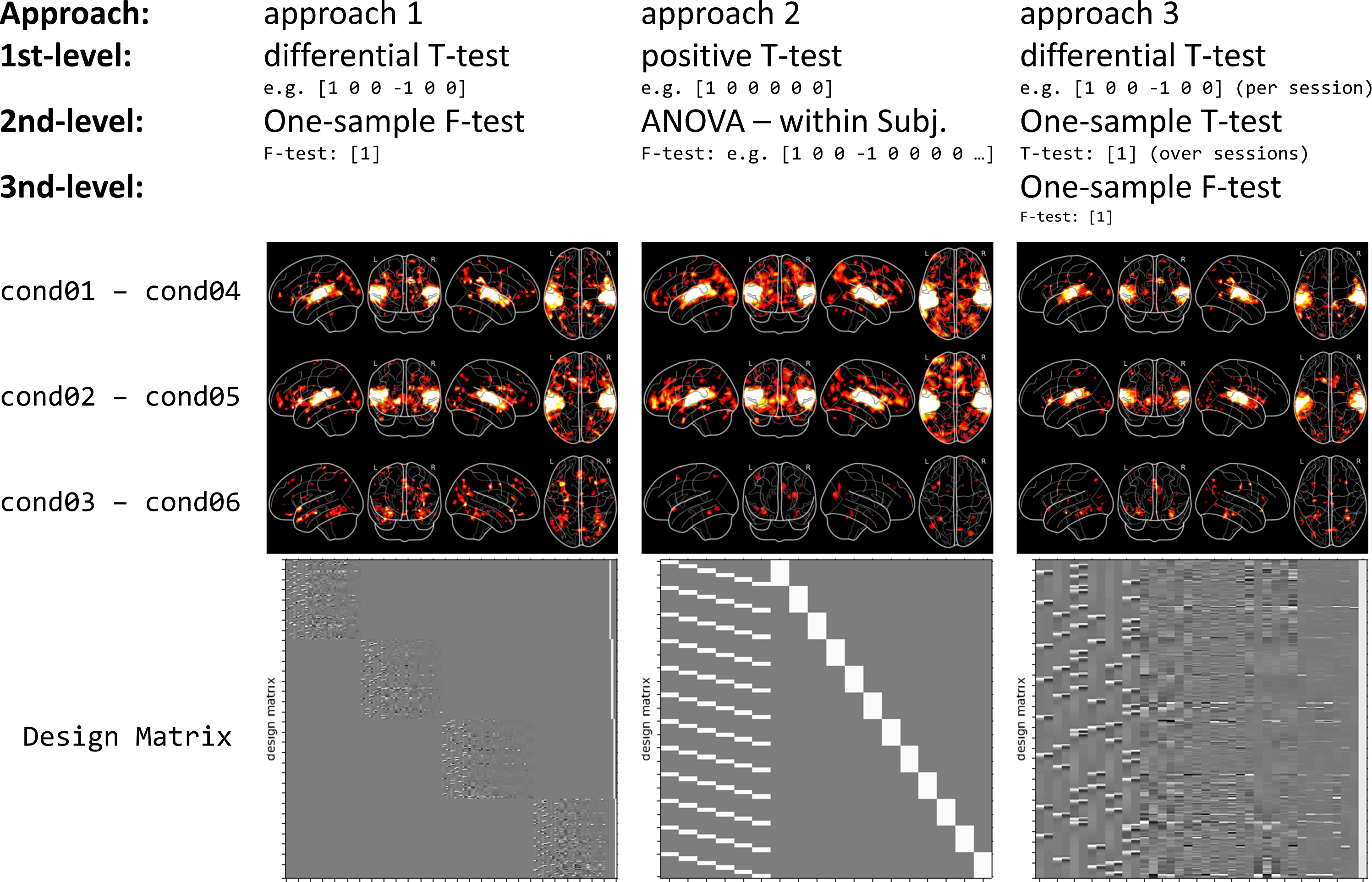
Follow-up 1:
Is approach 2 wrong in general or just because I have repeated measures? SPM allows user to specify if conditions within factors are independent or not and if they have equal varinace or not. So by specifying that the factor “Repetition” is dependent and has equal variance, I would get a design matrix as follows:
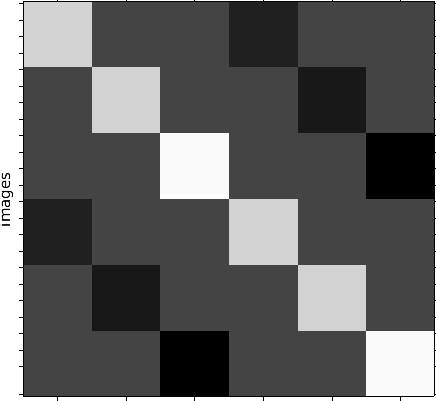
Would that make approach 2 again legitimate?
Follow-up 2:
Thank you for your interaction example. Testing the interaction would be of course the next step. You have a good video that explains nicely how to setup such interaction contrasts in general (https://www.youtube.com/watch?v=pwU32mnID-I&t=9m49s), but I realized that your approach and the one that SPM sets up automatically differ “visually”.
Where yours is anchored to the last condition, the one from SPM is more like a “staircase”:
a1: 	1	0	0	-1				b1:	1	-1	 0	 0
a2: 	0	1	0	-1		and		b2:	0	 1	-1	 0
a3: 	0	0	1	-1				b3:	0	 0	 1	-1
Am I assuming correctly that they are actually the same? Because b1 = a1-a2 and b2 = a2-a3
Follow-up 3:
Independent of my approach: If I want to compute such an F-Test, do I perform it always on the 1st-level and use a simple One-sample T-test on the 2nd- and/or 3rd-level?
Bonus FSL Question:
Thank you for the link to Thomas Nichols’ flameo example. In the guide he mentions 4D COPE and 4D VARCOPE images. I’m not familiar with FSL’s terminology, but in this context, the 4D COPE files are the preprocessed functional images, correct? What would the 4D VARCOPE stand for?
Thank you again for your help.
Cheers,
Michael